
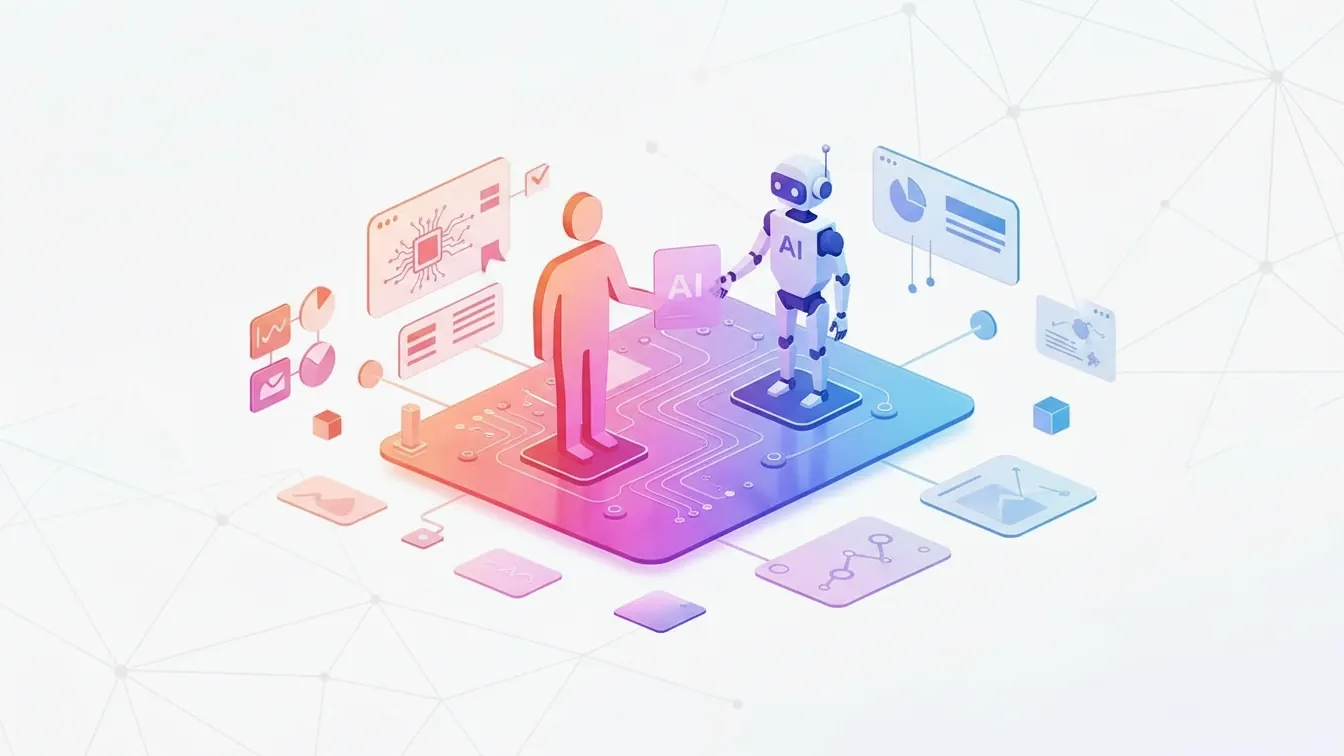
Business AI Agents: The Trends Shaping 2027
Business AI agents create value when they coordinate specific processes using reliable data, limited permissions, human oversight and operational metrics. The priority is not buying more assistants, but auditing operations, choosing a bottleneck and reviewing results every quarter.
Puntos clave
- •Agents coordinate objectives and actions; assistants respond to instructions.
- •The architecture must include tools, permissions, traceability and stop conditions.
- •The strongest initial use cases combine sufficient volume, accessible data and manageable risk.
- •Integrations and knowledge bases determine the quality of business decisions.
- •The strategy should be reviewed quarterly using time, quality, cost and control metrics.
AI Agents for Businesses: Trends Shaping 2027
Business AI agents are moving from isolated demonstrations to supervised operations. The difference from an assistant is not the name: an assistant responds when a person asks a question; an agent receives an objective, plans steps, queries systems, takes action, retries when something fails and requests approval when the risk requires it. Specialist guidance places this boundary in the realm of architecture decisions, not licence purchases.
- An agent can chain tools and intermediate decisions to complete an objective.
- Useful autonomy requires limited permissions, traceability and human oversight.
- Generative AI and agentic AI are complementary, not competing technologies.
- Non-deterministic processes are better candidates than simple, repetitive tasks.
- Quarterly reviews should measure operational outcomes, errors and risk, not usage alone.
What is the leading trend in business AI agents?
The leading trend is the shift from assistants that produce answers to systems that coordinate actions within business processes. An assistant can draft an email or summarise a contract; an agent can receive the objective of reviewing invoices, query the procurement system, compare amounts, flag exceptions and request approval before changing a record. Specialist sources describe precisely this difference between responding within a conversation and executing a multi-step task using external tools.
The reason is operational. Many businesses have already tested artificial intelligence tools, but they still enter data manually, copy information between their customer management and billing systems, or search for procedures across scattered folders. Buying another licence does not fix a broken chain. Value appears when the system connects to the real process and can act within defined boundaries.
The outlook for 2027 should be cautious: narrowly scoped agents for specific workflows, with explicit permissions and human escalation, will grow, while promises of universal autonomy will lose their appeal. Measurement should focus on cycle time, correctly escalated exceptions, the percentage of tasks completed without intervention and cost per operation. Tool usage alone does not demonstrate a return.
The distinction also has institutional support. Specialist public guidance explains that generative AI produces content, while agentic AI can decide the workflow, select tools and alter the course of execution. The same source notes that not every use case needs agents: when deterministic automation handles the work well, adding autonomy introduces complexity without a clear benefit.
Which trends are most mature, and what action does each require?
Maturity does not depend on how impressive a demonstration looks, but on process stability, data quality, permission clarity and the ability to audit every decision. The following table ranks the trends using that framework. Maturity is an editorial assessment intended to guide decisions, not an official market classification.
| Trend | Operational maturity | Likely impact | Recommended action |
|---|---|---|---|
| Agents limited to one process | High | Less manual work and faster response times | Choose a measurable workflow and limit its permissions |
| Agents connected to multiple tools | Medium | Less data duplication and fewer hand-offs | Review APIs, owners and data quality |
| Risk-based human oversight | Medium-high | Lower exposure to errors and sensitive decisions | Define when to approve, stop or escalate |
| Teams of specialised agents | Medium-low | Coordination of complex tasks | Start by testing one coordinator and recording traces |
| General-purpose cross-functional autonomy | Low | Uncertain benefit and elevated risk | Do not prioritise it without process evidence |
| End-to-end behaviour evaluation | Medium | Better quality control and compliance | Create test cases before launch |
A business’s first action should not be choosing a model, but identifying which decision and which tool the agent needs to coordinate. An agent that classifies enquiries may have a clear boundary; one that changes prices, payments or contracts needs much stricter controls. Impact should be expressed using a baseline: how many cases arrive, how long each takes, how many exceptions occur and who resolves them today.
Why does architecture matter more than the assistant you choose?
Architecture matters because an agent is not an isolated language model. It is a system made up of a model, instructions, memory or context, tools, authorisation rules, retrieval mechanisms, event logging and a human intervention route. If any of these components fails, a seemingly convincing response can produce the wrong action.
Institutional sources distinguish between orchestration, where a central controller orders the steps, and choreography, where several components react in a more distributed way. For a small business, this difference is not academic. A centralised workflow is usually easier to test and audit; a distributed architecture may offer flexibility, but makes it harder to identify responsibility when something goes wrong.
The reason for this complexity is that the execution path is not completely predefined. The agent may choose a tool, assess an intermediate result and change its next step. That is why the recommended action is to design the perimeter first: permitted tools, data it can read, actions it can perform, maximum number of retries, stopping conditions and the person responsible for approving exceptions.
Measurement should include the correct execution rate, false positives, retries, stoppages and trace quality. It is also worth testing edge cases: incomplete data, unavailable APIs, expired permissions and ambiguous requests. An agent that performs well in a demonstration but leaves no record of why it acted is not yet ready for critical operations.
Which processes should adopt AI agents first?
The best candidates are processes with sufficient volume, known business rules, accessible data and an outcome that a person can review. Automation should be proportionate to risk. Reviewing an internal query about a procedure may allow an automatic answer with a source; approving a payment or changing a contractual term should require human confirmation.
A suitable process usually contains several intermediate decisions. For example, a sales enquiry may require checking the customer’s history, confirming availability, calculating an authorised commercial term and preparing a proposal. An assistant helps a person complete these steps; an agent can coordinate them, provided that permissions and rules are defined.
The recommended workflow is:
- Map the real process. Document inputs, owners, systems, exceptions and the expected outcome without confusing the written procedure with day-to-day practice.
- Establish a baseline. Measure volume, cycle time, errors, approximate cost and reliance on specific people over a representative period.
- Classify the risk. Separate informational actions, reversible actions and actions with financial, legal or reputational impact.
- Build a narrowly scoped pilot. Connect only the tools that are needed and limit the scope to an observable outcome.
- Evaluate before expanding. Compare the pilot with the baseline and review errors with the people who carry out the process.
Flap Consulting’s AI Process Audit fits at this point because it reviews operations across departments, identifies where the chain breaks and delivers a bottleneck map prioritised by financial impact. It does not start with a specific tool; it starts by asking which work should change and what should remain under human control.
How should business AI agents be measured?
Agents should be measured as complete operating systems, not text generators. The quality of an answer is only one variable. It also matters whether the agent chose the right tool, respected permissions, interpreted data correctly, stopped when faced with an exception and left enough of a trace to reconstruct the execution.
This article’s forecasting framework combines four signals: technical capability described by specialist sources, applicability to business processes, oversight requirements and evidence of results in the organisation’s own operations. Agent evaluation should review planning, tool selection, rule compliance, stopping behaviour and auditability. This is more useful than counting public demonstrations.
An evaluation dashboard should include at least these dimensions:
- Outcome: percentage of cases that reach the objective without manual correction.
- Efficiency: cycle time and human work required per case.
- Quality: errors, incorrectly classified exceptions and unnecessary repetitions.
- Control: blocked actions, approval requests and available traces.
- Resilience: behaviour with incomplete data, connection failures and format changes.
- Adoption: sustained use by the people responsible for the process, not only during the pilot.
The European Union’s Artificial Intelligence Act reinforces the importance of human oversight. For a business, this obligation translates into design decisions: who can approve, what information they receive, how long they have to review it and what happens if they do not respond. Measurement should be repeated using real cases and updated whenever systems, rules or the model in use change.
What role will integrations and knowledge bases play?
Integrations and knowledge bases will be the infrastructure that determines whether an agent creates value or merely produces plausible answers. An agent cannot make reliable decisions if it is querying incomplete, duplicated or outdated data. Nor can it take action if the source system lacks suitable permissions, stable interfaces or a way to confirm the outcome.
This trend responds to a common problem in small businesses and family-run companies: processes have grown faster than their systems. Teams enter the same data into several tools, keep decisions in emails and rely on one person who knows the shortcuts. In this context, adding an agent before organising the information amplifies the confusion.
The recommended approach is to separate two tasks. First, connect the customer management system, billing, email, inventory or operations system so that data is entered once and reaches the right destination. Then build a knowledge layer that makes procedures, contracts and historical records searchable with their sources. Flap Consulting’s Business Knowledge Base addresses this second need: it reduces search time and dependence on key people without presenting an answer stripped of context.
Measurement should check data freshness, source coverage, the percentage of answers with a verifiable reference and the rate of actions rejected because of insufficient information. Integration is not a minor technical detail: it determines what the agent can know, what it can do and how you can prove that it acted on a valid version of the data.
What will not happen with AI agents in the short term?
Negative predictions are useful because they discourage investment based on promises that are difficult to verify. The first is that human oversight will not disappear from processes with legal, financial, employment or reputational impact. The greater the operational autonomy, the greater the need to define limits, approvals and stopping mechanisms.
The second is that not every automation will become an agent. A fixed validation workflow, a scheduled transfer or a rule-based notification may be cheaper, more predictable and easier to audit without autonomy. Agents can be excessive when a simple system handles the task.
The third is that buying assistants will not, by itself, transform fragmented operations. A business may have access to artificial intelligence while still dealing with duplicated data, unreliable metrics and decisions concentrated in one person. Transformation requires process design, integration, ownership and maintenance.
These counter-predictions produce three practical tests: require a baseline before announcing savings, compare an agent with conventional automation in the same process and reject any pilot that cannot explain its permissions and stopping conditions. The objective is not to appear advanced, but to remove repetitive work without shifting the risk elsewhere in the team.
What four actions should a business take this quarter?
The first action is to select a specific process and define its expected outcome in operational terms. “Use artificial intelligence” is not a useful objective; “classify support requests and route exceptions with all the necessary information” makes scope, quality and accountability measurable.
The second action is to conduct a process audit. The team should observe how work is actually done, identify isolated systems, record exceptions and estimate the cost of bottlenecks. An audit prevents the business from building an agent on a procedure nobody follows or on data without an owner.
The third action is to prepare a pilot with minimum permissions, traceability and human approval. The pilot should include normal and difficult cases, as well as a comparison with the previous situation. Flap Consulting’s Custom Automations are a natural option when the main problem is connecting tools, generating documents, sending notifications or validating information without adding an unnecessary layer of autonomy.
The fourth action is to create a small operational committee to review results, risks and changes. It should include the process owner, someone from technology or data and the people who perform the work. The committee needs the authority to stop the pilot, correct rules and decide whether the result justifies expanding its scope.
These actions also clarify when an External AI Department is appropriate. A small business may need ongoing development, maintenance and integration but lack the scale to hire an internal team. In that situation, the value is not in receiving a closed tool, but in retaining technical capability that understands the operation and responds when it changes or breaks.
How should an agentic strategy be reviewed each quarter?
The quarterly review should compare reality with the original hypothesis. The team should examine processed volume, cycle time, the percentage of human intervention, errors, operating costs, security incidents and the satisfaction of those receiving the output. If the agent does not improve a relevant metric or creates as much corrective work as the saving, the right decision may be to reduce its scope or replace it with simpler automation.
The review should also check whether connected systems, permissions, procedures, reference data or applicable regulations have changed. An agent that worked with a stable field can degrade when an application changes its structure. Traces should make it possible to answer what objective the agent received, which tools it used, what data it consulted, which intermediate decisions it made and why it did or did not request approval.
Each quarter should end with an explicit decision: maintain the scope, expand into an adjacent process, correct the architecture, pause the agent or retire it. This discipline prevents a pilot from becoming critical infrastructure without an owner. It also turns forecasting into learning: market trends matter, but the organisation’s evidence decides.
In 2027, business AI agents will be valuable where they coordinate real work with clear boundaries, accessible data and oversight proportionate to risk. The next step is not to buy more licences: it is to choose a process, measure its baseline and decide, using evidence, which part deserves automation, which part needs an agent and which part should remain under human judgement.
Frequently asked questions
What is the difference between an AI assistant and an AI agent?
An assistant waits for an instruction and returns an answer or performs a requested action within a limited context. An agent receives an objective, can break it into tasks, choose tools, query systems, assess intermediate results and continue until the work is complete or human intervention is required. The practical difference lies in autonomy and architecture, not the commercial label. An assistant may be the right choice when a person remains in control of every step.
Which process should a small business automate first?
A small business should start with a frequent, measurable process that uses accessible data, such as classifying enquiries, preparing documents or transferring information between systems. It is best to avoid irreversible decisions or those with significant legal impact at first. Before building anything, the business should measure volume, time, errors and exceptions. A process audit can identify the bottleneck with the greatest potential return and establish whether conventional automation is sufficient.
Do AI agents replace human oversight?
Not in high-risk processes. Human oversight must define which actions an agent can perform, when approval is required, when it must stop and how its records are reviewed. The level of oversight depends on the impact of an error and whether the action can be reversed. It may be light for informational and reversible tasks; for payments, contracts, employment decisions or critical data changes, it must be explicit and verifiable.
What data does an AI agent need to work effectively?
It needs relevant, up-to-date data that is accessible with appropriate permissions and structured well enough for the process. It also needs clear procedures and an identified source of truth. If information is duplicated or scattered, the agent may select the wrong version and take a coherent action based on incorrect data. This is why system integrations and a knowledge base with verifiable sources are usually prerequisites, not later enhancements.
How do you calculate the return on an AI agent?
Return is calculated by comparing the previous and subsequent situations using an operational metric: cycle time, cost per case, resolved volume, errors or released capacity. The business must deduct the costs of building, integrating, maintaining and supervising the agent, as well as correcting incidents. It should also consider risks avoided, such as loss of knowledge when a key person leaves. Increased usage without measurable improvement does not demonstrate a return.
Should you build an AI agent or buy an off-the-shelf solution?
It depends on how unique the process is, the quality of the integrations and the risk associated with the action. An off-the-shelf solution may be enough for a common, clearly defined task. Custom development makes sense when the workflow depends on proprietary rules, several internal systems or specific permissions. The decision should follow an operational analysis, not precede it. Flap Consulting starts with that diagnosis to decide what to build, what to connect and what not to automate.